
Treatment
A world-first: Simple & safe treatment.
The Alison Lawson Clinic is pleased to provide a simple, safe, effective and non-invasive treatment for visual dyslexia and learning difficulties. Invented by Alison Lawson (a university-trained orthoptist with
over 60 years of experience in Australia & England), the treatment program is renowned for its use.
What is Dyslexia?
The word dyslexia comes from the Greek language, and its literal translation is ‘dys’ – difficult, ‘lexis_ – words; hence difficulty with words.
It is evident therefore that any child or student experiencing such difficulty will have a difficult time in an environment such as school which is book based. School and society value those who acquire a good standard in literary and literacy skills – precisely those skills which dyslexic people find so difficult to master.
Dyslexia is a ‘hidden handicap’ and can be very frustrating. Although it is not related to intelligence, the person may be misdiagnosed and frequently regarded as lazy, forgetful and inattentive, even slow and stupid. Consequently many have very low self-esteem. It is therefore very important that all teachers and parents are informed and experienced enough to identify the dyslexic child early in a school career. The teacher should provide appropriate assessment and teaching, and be able to monitor the child’s progress regularly and carefully.
The Science
The eyes and the brain need to work together.
The successful treatment of dyslexia is heavily involved with the visual cortex, which is at the back of the brain. In pure medical terms, it is situated on the medial aspect of the occipital lobe in relation to the calcarine fissure. It is characterised by the distinguishing white line or stria of Gennari, which is visible to the naked eye.
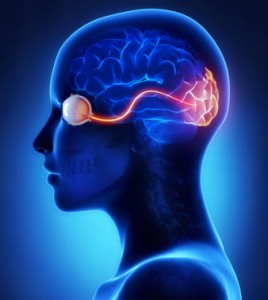
The cellular structure of the visual cortex is of the highly granular type associated elsewhere in the cortex with sensory function. The outer and inner granular layers are made up of small granular cells densely packed.
A simple analogy of the visual cortex likens it to that of a ‘layer cake’ with 7 layers, the eye simply being the camera. Utilising the LASD, the larger discs stimulate the upper layers of the visual cortex and the finest bands stimulate the deepest layer of the visual cortex.
The eye is like the camera and the visual cortex in the occipital (lower back part of the brain) area is the main receiving station of the visual impulses, whilst the frontal lobe (upper area) of the brain interprets what is being seen.
A check is made on the aiming point of each eye. There should be steady binocular fixation.
However, many times the fixation of one macula is very unsteady, or there can be an eccentric fixation. Demonstrating the main cause for the learning problem, the patient is able to obtain a clear focus at any level of gaze, but it cannot be maintained. As fixation fails, so does the patient’s concentration. As there is unsteady or incorrect fixation, the frontal lobe of the brain lays down deep central suppression in the visual cortex (occipital cortex) of the affected eye.
Treatment for Dyslexia and Learning Difficulties
Treatment consists of an average of ten (10) one hour sessions utilising the Lawson Anti-Suppression Device (LASD). The LASD machine was first used in 1988 for the treatment of Visual Dyslexia.
Activating the entire population of visual neurones in the visual cortex, the LASD utilises a range of 7 (seven) different spatial frequency gratings. These revolve through 360 degrees at a speed of one rev. per minute to directly treat the area of the problem in the visual cortex.
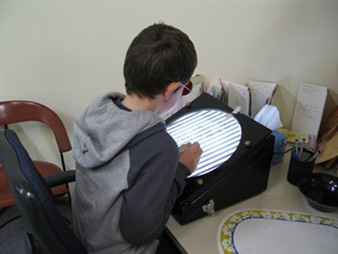
The eccentric or unsteady central macular fixation in the eye is treated by applying a pleoptic red filter in front of the effected eye (the macula is particularly sensitive to red), while the eye with the central macular fixation is patched.
The patient views green/blue/black literacy targets through the pleoptic red filter and works with puzzles, words, math, sequencing, letters, numbers and games. These are designed to suit the age and ability of the patient.
When both eyes are holding focus, the normal binocular reflexes may then be trained. Work is then continued on the machine with the full range of coloured targets. This stimulates the full body of the cone receptor cells, progressing through all the discs to the finest, while the puzzles and literacy tasks encourage higher intellectual stimulation of the frontal lobe.
There is specific homework in between sessions that supports the treatment. It is important to have full co-operation with patient and with parents/teachers if applicable, and that the set protocol is followed for maximum outcome to be achieved.
Finally the patient then has a higher standard of focusing than the average person, with full binocular single vision at every level of gaze. Wide amplitude of dissociation between convergence and accommodation is achieved. Therefore, full control from the frontal lobe of the brain is achieved, so that this treatment will last throughout life. No further eye exercises are required.
Signs & Symptoms of Dyslexia
- Reading difficulties
- Work unfinished
- Spells badly
- Poor comprehension
- Forgetful
- Can read but does not read for pleasure
- Difficulty reading aloud
- Words moving/print distortions
- Easily distracted
- Behaviour problems
- Poor sporting ability
- Lacks confidence
- Low self esteem
- Headaches and tiredness
- Reverses Letters
- Labelled Dyslexic or ADD

If you or your child displays symptoms listed please CONTACT US to arrange an assessment. We can accurately diagnose in one hour and then discuss treatment if required.
Click here to complete our Signs & Symptoms Checklist.
Fast Facts: